
5 Common Résumé Mistakes Actors Make (and How to Fix Them)
The résumé mistakes that signal inexperience—and how to correct them immediately

This article is part of the free tier of Cast Forward — created to help actors build smarter, more sustainable careers. My paid subscribers get full deep-dive articles (every other Saturday), career strategies, and occasional casting notices. If you’re looking for more in-depth insights, personalized strategies, and industry tips, consider joining us!
One of the biggest misconceptions actors have is thinking their résumé is just a formality.
It’s not.
Your résumé is a positioning tool. It tells casting directors how to see you before you even walk into the room.
And small mistakes can quietly cost you opportunities.
Here are five of the most common ones—and how to fix them.
1. Listing Skills You Can’t Actually Do
This one is simple, but it happens all the time.
Actors list accents or special skills they’re not fully comfortable performing.
The problem is:
casting may ask you to demonstrate it immediately.
If you can’t deliver, it doesn’t just look unprepared—it raises questions about your credibility.
Fix:
Only list accents you can perform consistently and under pressure
Only include skills you can execute on camera, not just “kind of do”
Treat your skills section like a promise, not a wish list
2. Using a Corporate Résumé Format
Your acting résumé is not a job application for an office role.
Casting directors scan quickly. They expect a specific layout that highlights your credits, not your responsibilities.
A corporate-style résumé isn’t appropriate for actors—it doesn’t follow industry standards and immediately signals inexperience.
Fix:
Use a standard industry format (Film, TV, Theatre sections)
Keep it clean, minimal, and easy to scan
Prioritize your credits, role types, and key production details like the project name, director, or network—not descriptions of your role.
3. Including Your Age or Age Range
Including your age or age range is not standard practice in the industry and can work against you.
Casting is based on how you present on camera, not a number on a page.
Including your age limits how they perceive you before they even see you.
Fix:
Remove age and age range entirely
Let your headshot and presence define your casting range
4. Grammar Mistakes and Misused Industry Terms
This is where a lot of actors lose credibility without realizing it.
Simple spelling mistakes or incorrect terminology signal a lack of attention to detail.
One of the most common errors:
Writing “principle” instead of “principal”
These are not interchangeable.
Here’s where it matters even more—terminology differs slightly between the U.S. and Canada.
Principal (Canada):
A speaking role, often defined in practice by line count.
Supporting (USA and Canada):
A narrative category for speaking roles that support the lead.
In the U.S., this can range from smaller to more substantial parts
In Canada, it typically implies a more significant role
If you’re submitting across markets, using the wrong terminology can create confusion about your experience level.
Fix:
Double-check spelling, especially industry-specific terms
Use terminology appropriate to the market you’re targeting
Keep your résumé aligned with professional standards
5. Not Including Your Status
This is one of the most overlooked—and most strategic—elements.
Your status can directly impact whether casting considers you.
If they don’t know you can legally work or travel, they may move on.
Fix:
Include relevant status details at the top of your résumé under your name and union status, such as:
Valid passport
Work authorization
O-1 Visa
Green Card
Dual citizenship
This removes friction and makes it easier for casting to say yes.
The Bottom Line
Your résumé is not just a list of credits.
It’s a signal.
Every detail either builds confidence or creates doubt.
Most actors don’t lose opportunities because they lack talent.
They lose them because their materials don’t position them correctly.
If You Want to Take This Further
In my premium deep dive, I break down how to strategically structure your résumé so it actually attracts opportunities—including how to position your credits, format your sections, and present yourself at a top-tier level.
That’s where the real shift happens.

One More Thing Most Actors Don’t Realize
Fixing your résumé is one part of the equation.
But here’s where most actors get stuck:
They update their materials…
and then nothing happens.
Because they’re not tracking:
who they’re submitting to
what roles they’re targeting
which materials are working
where they’re getting traction
And without that, it becomes guesswork.
The actors who actually build momentum treat their career like a system.
They track submissions.
They refine their materials based on real responses.
They know exactly what’s moving the needle.
That’s the difference.
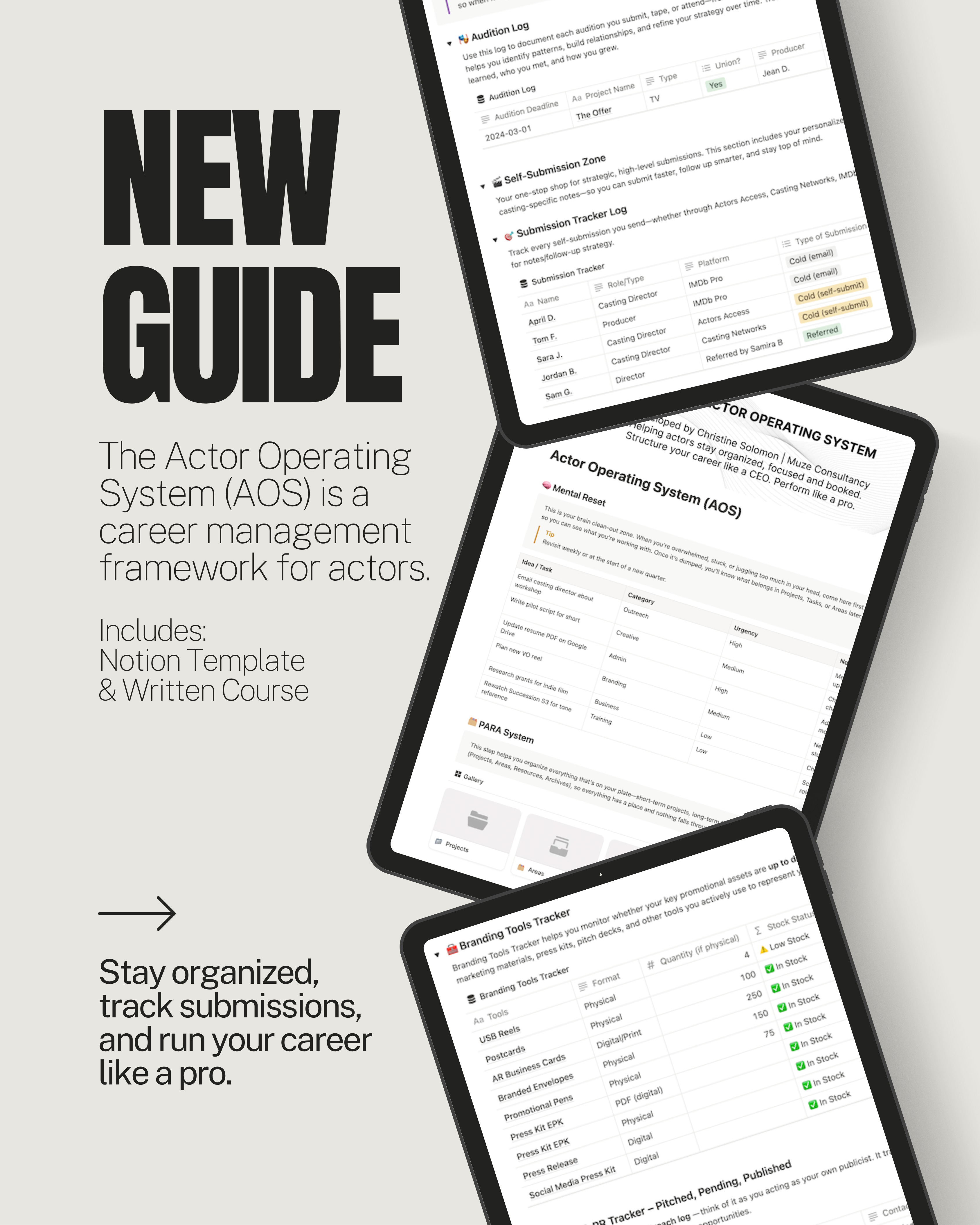
If you want a structured way to do that, this is exactly why I built the Actor Operating System—to help you organize your outreach, track your submissions, and position yourself strategically instead of randomly applying.
Because at a certain level, it’s not about having the right materials—it’s about knowing how to use them strategically.
Refining What Happens After the Résumé
A strong résumé gets you an audition.
What happens next is what keeps you there.
That’s where real training matters—how you show up, how quickly you adjust, and how truthfully you bring the character to life.
If you’re actively working or pushing into higher-level opportunities, renowned acting coach Miranda Harcourt is currently running a Zoom masterclass focused on that exact transition from preparation to performance.
Her approach is not theoretical. It’s built around real-time adjustments.
Actors work on monologues and scenes while she identifies what’s not landing and gives direct, practical corrections you can apply immediately.
The structure is simple and focused:
Three live sessions (four hours each)
Actors work with monologues and scenes
Selected participants perform live and receive direct coaching
Others submit self-tapes and receive written feedback
All participants observe and apply the work in real time
The focus is on connection, internal life, behavior, and creating truthful moments on camera from the start—the same qualities casting is looking for once your résumé gets you through the door.
Details:
Dates: May 16, 23, and 30, 2026
Format: Live Zoom masterclass
Duration: 12 hours total
Time: 5–9 PM Pacific / 8–12 PM Eastern
Includes recordings and follow-up materials
This is not a general class. It’s designed for actors who are already working or seriously pursuing professional-level performance.
Spots for direct coaching are limited and based on application.

To enquire about cost: miranda@mirandaharcourt.com
Coming Up Next on Cast Forward
Here’s what’s on the way:
The Essential Acting Gadgets (and Apps) Every Performer Needs
Questions You Should Ask Before Taking a Workshop
Mindset & Productivity: How to Stay Focused & Achieve Career Breakthroughs
Career PR: How to Get Featured in Trade Publications & Build Hype
What to Do When You Haven’t Booked in Months
The Smart Way to Use Social Media to Boost Your Acting Career
Brand Positioning: How to Get Casting Directors to See You as a Leading Actor
🔜Coming Up Next For VIPs
Verified industry contact lists. We are starting with:
1. Theatres (open for general auditions)
2. Casting Directors
3. Photographers
4. Demo Reel Editors
5. Headshot Reproduction Labs
How SAG-AFTRA vouchers, ACTRA credits, and other union pathways really work — clearing up the confusion once and for all.
Industry Resources and Casting Platforms Every Actor Should Know
A verified list of Canadian casting directors with active casting notices, newsletters, and/or submission forms
This is fantastic and as a casting director I really hope that people repost this again and again because it should be required reading.