
If You Do One Thing Every Day for Your Career, You Will Advance
A simple execution rule that compounds over time and quietly moves careers forward

This article is part of the free tier of Cast Forward — created to help actors build smarter, more sustainable careers. My paid subscribers get full deep-dive articles (every other Saturday), career strategies, and occasional casting notices. If you’re looking for more in-depth insights, personalized strategies, and industry tips, consider joining us!
(The rule I’ve followed for years)
Most people think career advancement comes from big breaks, perfect timing, or being “discovered.”
That’s not how it actually works.
Careers move because of consistent, intentional action. Not motivation. Not luck. Not talent alone.
For years, I’ve followed one simple rule:
I don’t go to sleep unless I’ve done at least one thing that moves my career forward.
Sometimes it’s one thing. Sometimes it’s three.
Some days it’s small. Some days it’s long.
But it’s never zero.
And over time, that rule compounds.
Why One Thing a Day Works
This isn’t hustle culture.
It’s direction.
When you commit to doing at least one intentional career action every day, a few things happen:
Progress compounds quietly
You stop waiting to feel motivated
Confidence builds through evidence, not hope
Momentum continues even when nothing external seems to be happening
Most careers stall not because people aren’t talented, but because nothing is being done daily to move them forward.
How I Structured My Career Progress
I never woke up asking, “What should I do today?”
I already knew.
Step 1: Start With the End Goal
I always had a clear long-term goal. Not a vague wish. A real outcome.
Step 2: Break It Into 12 Months
Then I built a strategy around the goal.
Instead of asking, “How do I get there?”
I asked, “What needs to happen this month to move me closer?”
Each month had specific objectives tied to that larger goal.
Step 3: Turn the Month Into Daily Actions
This is where most people get stuck.
I list everything required for that month. For example:
Submissions
Outreach
Meetings
Press
Events
Follow-ups
Research
Preparation
Then I distributed those tasks across days.
No perfection. No waiting. Just execution.
The Cardboard Method (and Binder)That Kept Me Consistent
Before everything was digital, I used something very simple: a piece of cardboard and a binder.
The cardboard gave me visibility.
The binder gave me structure.
I divided the cardboard into three sections, depending on the focus of the month.
For example:
Press and visibility
Events and rooms I entered
People I met or reconnected with
Alongside that, I kept a binder, which functioned as my early version of the Actor Operating System. That’s where I organized the details behind what was on the board and beyond—contacts, notes, follow-ups, submissions, materials, and anything related to my career progress.
The cardboard stayed visible in front of me.
The binder held the structure behind it.
Every time I completed something, I wrote it down. Names. Articles. Events. Submissions.
This mattered more than people realize.
It gave me a visual overview of progress.
It replaced doubt with evidence.
It kept me moving when nothing seemed to be happening yet.
Momentum became visible.
Why This Works (Psychologically)
You don’t build confidence first.
You build confidence by doing.
Tracking progress:
Reduces overwhelm
Creates momentum through completion
Improves decision-making
Keeps you in motion during slow periods
This is how careers actually grow. Quietly. Consistently.
From Cardboard to a Career System
As my career grew, so did the complexity.
More submissions.
More contacts.
More materials.
More moving parts.
Eventually, cardboard wasn’t enough.
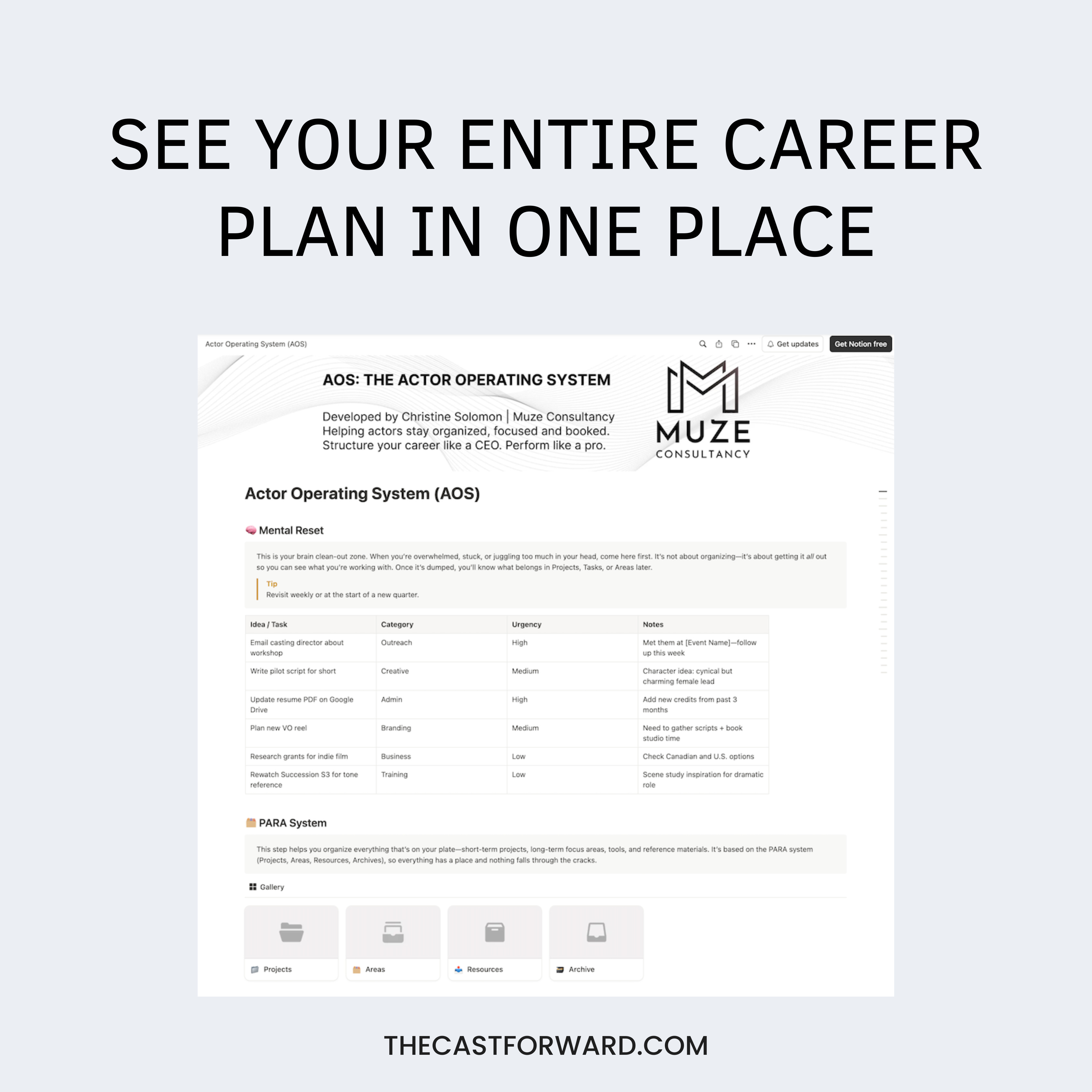
That’s when I translated this entire way of working into a digital system.
That system became the Actor Operating System.
What the Actor Operating System Is
The Actor Operating System is a Notion-based dashboard, not software you download.
It lives online and syncs across your computer, phone, and tablet.
It’s fully editable. You can customize it, expand it, or adapt it to how you work.
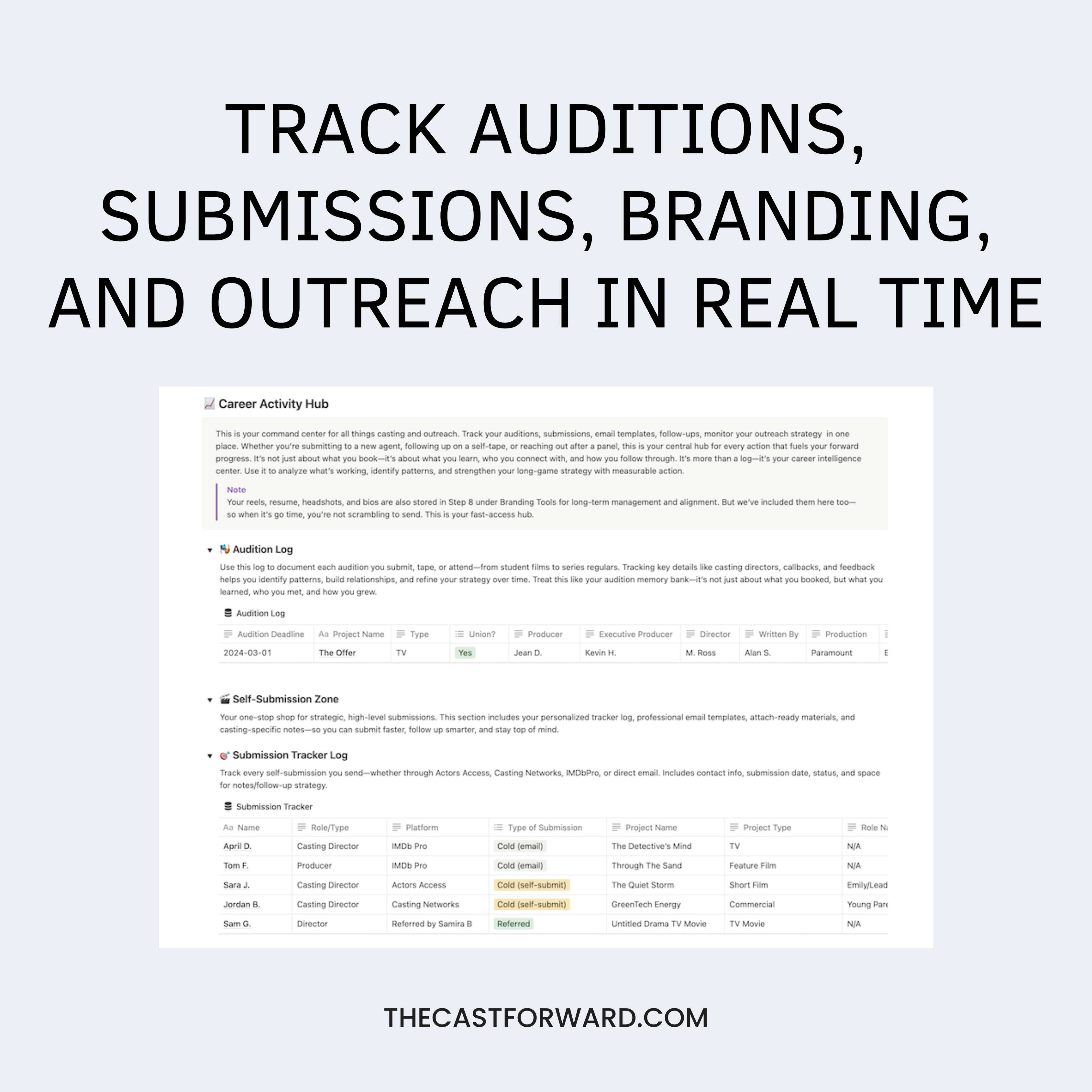
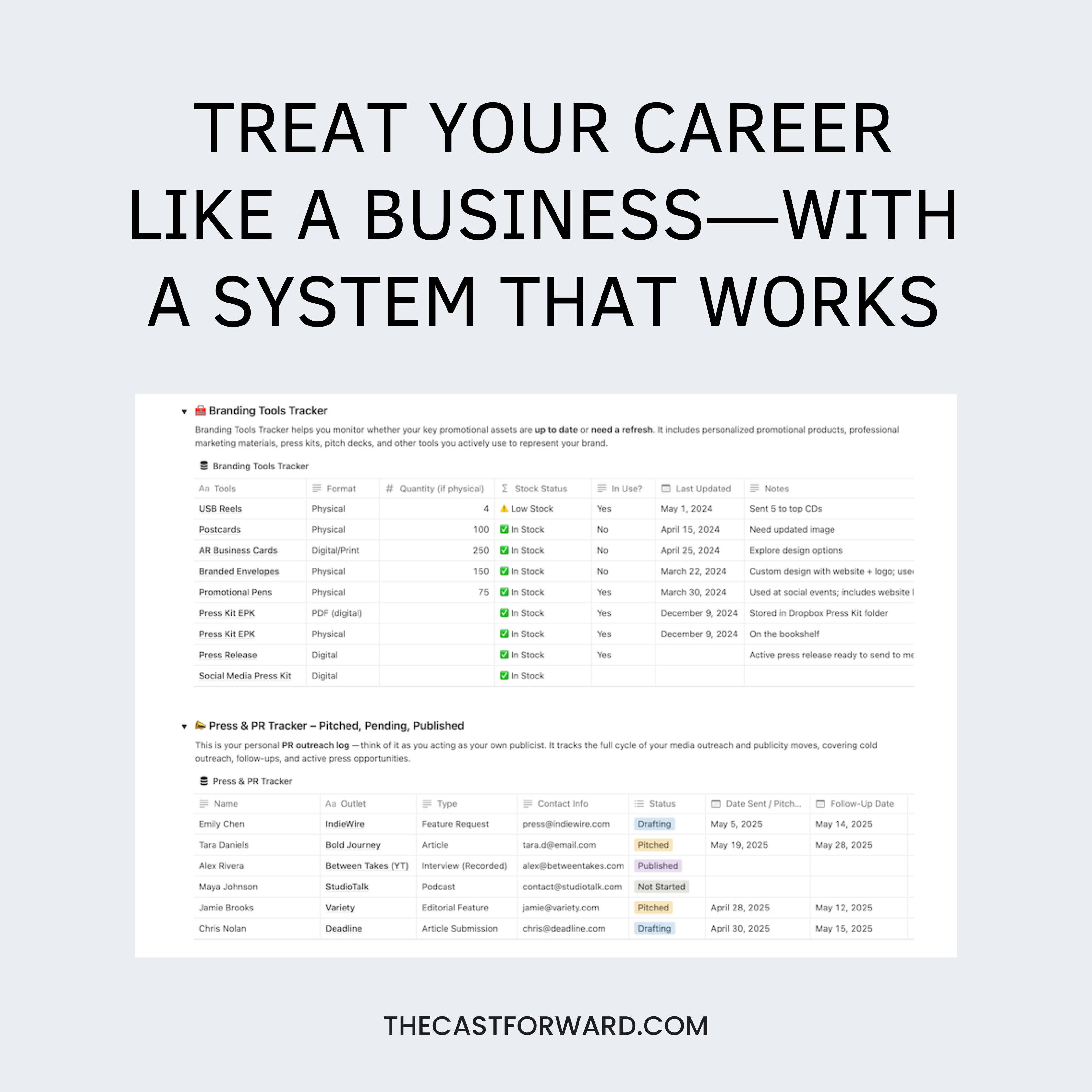
Actors use it to track:
Submissions
Contacts
Press
Meetings
Materials
Short-term and long-term goals
For larger files like headshots, reels, or contracts, I recommend storing them in Google Drive, Dropbox, or iCloud and linking them inside the system. Notion’s free plan has file size limits, so linking works better for most people.
It’s not about doing more.
It’s about seeing what you’re actually doing.
The Real Takeaway
Most people overestimate what they can change in a week
and underestimate what they can change by staying consistent.
You don’t need to feel ready.
You don’t need perfect clarity.
You don’t need a breakthrough moment.
You need a system that makes progress unavoidable.
When you commit to daily execution and give yourself a way to see it, something shifts. You stop questioning whether you’re moving forward, because the evidence is in front of you.
That’s how momentum is built.
Not loudly. Not overnight.
But in a way that lasts.
One thing a day doesn’t feel dramatic.
It just works.
If you want a structured way to manage this long-term, that’s why I built the Actor Operating System.
Coming Up Next on Cast Forward
Here’s what’s on the way:
A Step-by-Step Guide on How to Find an Agent—when to reach out, and how to submit effectively
How to Shoot Low-Budget Projects and use them to Strengthen your IMDb — including how to add “in development” listings and position your credits to attract agent interest.
Breaking down exactly how to land your first publicist, when you actually need one, and what to do if you can’t afford it yet. I’ll share how I found mine, what to look for, and what I wish I’d known at the start.
How to write a press release—A simple breakdown you can use to build your own.
🔜Coming Up Next For VIPs
Breaking Into the U.S. Market as an International Actor
Writing a Cover Letter that gets Attention—subject line strategies
A verified list of casting directors with active casting notices, newsletters, and/or submission forms
Verified industry contact lists. We are starting with:
1. Theatres (open for general auditions)
2. Casting Directors
3. Photographers
4. Demo Reel Editors
5. Headshot Reproduction Labs
How SAG-AFTRA vouchers, ACTRA credits, and other union pathways really work — clearing up the confusion once and for all.